For the last couple of months, we have been eagerly awaiting the arrival of my (Nathan's) parents and our friend Beth. My folks have come to spend 3 months working around Etnos and Beth came to spend a week with us. As a coffee barista, she really wanted to have an opportunity to see a coffee plantation.
Unfortunately, Bolivia's best coffees are produced in the Yungas region on the other side of the country. I put some feelers out anyway and found out that a coffee I occasionally purchase is produced only 2 hours' drive away from Santa Cruz on a plantation that includes a cabaña-style hotel with a swimming pool and a tour!
We thought we could only spare one night of Beth's week-long trip, but we wanted to make the most of it. So we rolled out first thing in the morning and headed north!
Packed into the Patrol. Kaylee rode in the jump seat with Addi and Lydia.
About two hours and 65 miles later, we arrived at the little town of Buena Vista, which means "good view" in Spanish. Our hotel, Hacienda El Cafetal, was just a couple miles off the highway, and boy did it have a view. It overlooks a national park that is reportedly full of jaguars, monkeys, and incredible birds. Throughout the 24 hours we were there, the weather changed quite a lot, making for some great scenery.
The main buildings of the hotel, as seen from the lookout tower
(Click here or here to see a 360-degree view from the lookout tower!)
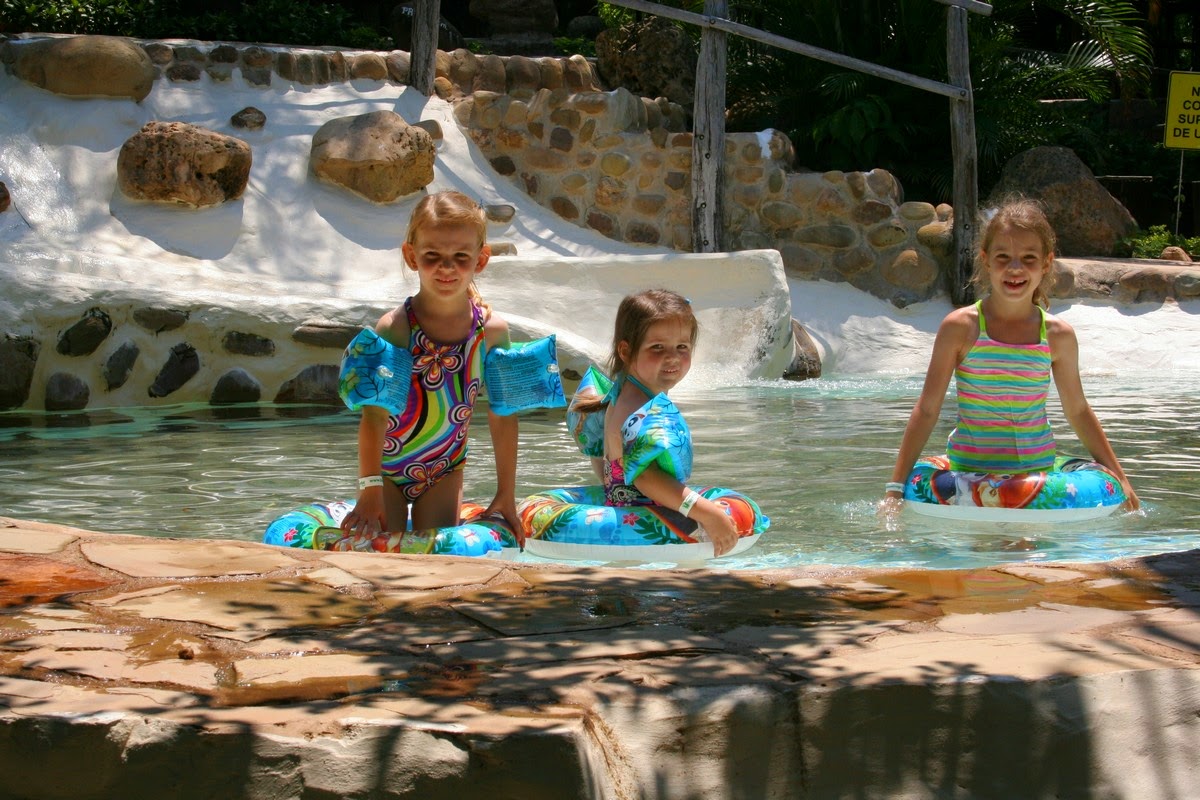
It was a great way to get out of town and relax a bit. Of course, the girls were mostly excited about the swimming pool and we stayed in it a good portion of the afternoon, in spite of a rain storm.
We were delighted to find out that, because it's the off-season, we were the only overnight guests and had the place pretty much to ourselves!
Once the weather cleared up, we inquired about the coffee tour. We were guided by Mario, who has been working at Buena Vista for 25 years in all aspects of production. He was very personable with a dry sense of humor that Kaylee and I enjoyed. Unfortunately, we had to translate to English for our guests, so some of it was lost, but we all had a good time.
We started with the coffee plants themselves and learned about the process of growing plants, caring for them organically, and harvesting:
Mario explaining details about the coffee fruit
The girls, with some 7-year old coffee plants
After we asked a lot of questions, we moved to the industrial side, where they service 1500 hectares of family coffee production. The plant processes 180-200 metric tons per year (harvested April-June), about 90% of which is shipped to the Netherlands as raw beans. The other 10% is roasted and ground for the national market.
The dryer brings the moisture level of the beans from 40% down to 12%
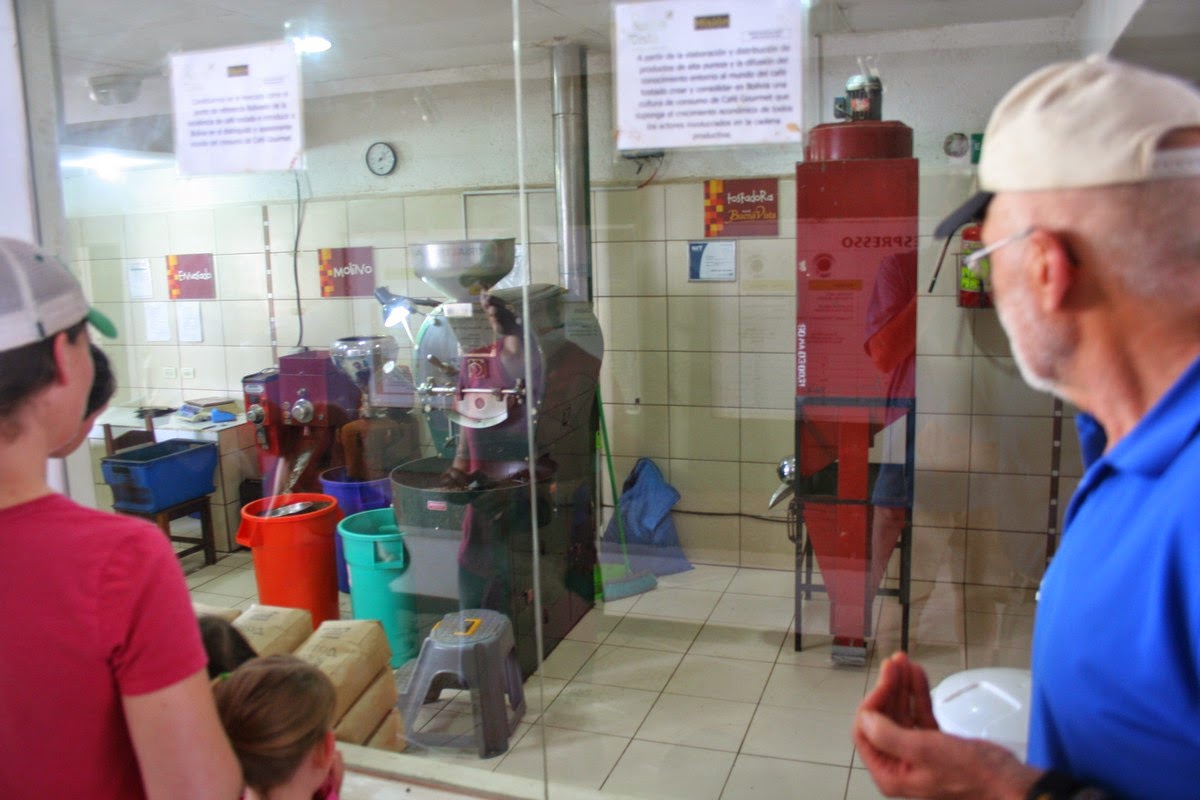
Looking into the roasting, grinding, and bagging room
The tour ends with an espresso served by our host, Abel.
Mario (r) chats with Abel (l) as he serves up espresso
Beth said, "It's not bad, just not very interesting."
We ended the day with Pique Macho in the hotel restaurant. The next morning, we had another swim, checked out, and went into town to see what Buena Vista had to offer. It was pretty quiet, but we found a cool place to take a photo on the plaza.
As usual, we took lots of photos, the best of which are in our Picasa Web Album.
As I wrote about a couple months ago, the Grammar Analysis class I am teaching this semester can be difficult, especially for those who are not inclined to be analytical. The coworker that prepared the materials for our last grammar class had used the subtitle "The Funnest Class" as a bit of ironic humor. I decided that Analysis needed something a bit darker and more direct, so I used "The Thorn In Your Flesh."
I did hope to get a laugh, but as I considered the implications of II Corinthians 12:9, I realized just how appropriate it could be in this situation. In this passage, God reassures Paul that his thorn had a purpose: to demonstrate Jesus' grace and power. I decided to include the verse as a daily reminder to prompt in the students the same reaction that Paul experienced in his own life: that they would rejoice in their weakness, allowing Christ's power to work through them.
The lead slide for my presentations
I expected them to get bored and discouraged with the material we were studying, and they did at times. I'm glad to say, though, that in the past 4 months they have all shown remarkable improvement in their ability to break down language. Yet, I know that most of them would say, "I'm not very good at this."
However, I can't take credit for their improvement either.
As I look back at the past year, I can honestly say that I love teaching. I have enjoyed preparing lessons, giving lectures, and doing personal tutoring. That said, these verses have been just as important for me. I, too, have gotten bored and discouraged. I have so much to learn about all three of those aspects of teaching that I just mentioned. There are so many ways I need to improve. I'm completely new at this and I have had days where I return home from class wondering if I actually communicated anything worthwhile at all.
Some say, "You never really learn something until you teach it" and I agree. I would also say, "You don't really know what fluency in a second language is until you try to teach in it." I feel like I have been completely stretched and wrung out in both my understanding of grammar analysis and of Spanish. I often have to "hunt" for words to describe concepts, because I still lack some of the technical vocabulary in this area. I sometimes get to the end of the 2-hour class so mentally fatigued that I can't utter a simple sentence without some glaring, basic error in pronunciation, gender, or subject-verb agreement. And for a grammar nerd, that's the worst thing that can go wrong!
That's why this passage is so beautiful. In the end, it's not really about me or my performance.
No one really knows what Paul's "thorn" was. There has been a lot of conjecture and a lot of good ideas, but the fact is that he left it unnamed. I believe that the Holy Spirit kept it hidden so that we could more freely apply this passage to our own difficult situations. If Paul had specified what his difficulty was, we would tend to categorize it and put the application of this passage in a box. As it is, we can take hold of the hope that is offered here and rest in Christ's work for us and through us.
Now, I wouldn't go so far as to say that my inexperience and inadequacy could be described as "a messenger of Satan," but they are a sign of weakness. And that's discouraging.
Kaylee has also experienced this. Although she speaks well, she struggles to express herself clearly in Spanish at the level at which she is accustomed to communicating in English. She is uncertain of cultural cues at church, around campus, and as a hostess in our own home. Yet God is using her, too, as she faithfully applies what she does know. She has had some good opportunities to advise and counsel both students and staff ladies, in the past few weeks especially.
We are not here in Bolivia because we are great missionaries, or great disciplers, great Christians, or even great people. The reality is that we are not great anything! We are weak. We have problems. We struggle. We are uncomfortable. We are inexperienced and have so much to learn. And that's a good place to be.
If we really contributed anything to this work, we would have something to take pride in. I don't know how others view us, but because we recognize our own weakness, we can see that it is Christ who is working in us and through us. It is His power that is shaping us and maturing us. If anyone else is blessed or changed by what we do, it is only because of His power being perfected in our weakness.
On Monday, we played hooky and took a long-overdue free day with friends. We're about 2/3 through the semester and I (Nathan) have been very focused on my job and needed to set it aside for a day with Kaylee and the girls. When our friends Dan and Jenny invited us to accompany them for a day off, I couldn't say no.
Spring has roared in like a lion (it's 100*F outside right now) and we wanted a pool. The only place we could find that was open on a Monday was the Güembé Biocenter, commonly known as the mariposario (butterfly park). We have heard about it for a couple years, but had not visited yet, in spite of many pleas from our daughters, who are very interested in butterflies.
We had to drive almost an hour to get there, since it's on the other side of the city and across the river, but we were very pleased at what we found. The park covers 60 well-sculpted acres and features an orchidarium, tremendous aviary, a swamp (with capybaras, deer, and rheas), 2 lakes (one with monkeys, one with kayaks), lots of swimming pools, and cabins. It's a beautiful setting and evidently taken care of.
The girls are avid butterfly chasers/catchers, so we had a look around before jumping in the pool.
Once we got in the water, though, they just wouldn't quit!
It was a great day to relax, have fun together, and experience something different!
Toucan in the walk-through aviary
Looking out at the city from the looking tower in the aviary
One of the goals of the Etnos training program is to give the students an opportunity each semester to get off campus, see more of Bolivia, and get a practical, realistic taste of what ministry can be like among the various ethnic groups of this country.
This past week I had the opportunity to accompany my coworker Howard and the 8 students to a village north of Cochabamba called Oromomo. It is a small community on the Sécure river, populated by 80 families of Chimane and Yuracaré ethnicity. Oromomo is accessible by river (a week or so, from Trinidad) or by air (one hour, from Cochabamba).
As we planned the trip, we talked about several purposes that we wanted to emphasize and I believe that we accomplished all of them:
-rustic living
-language and culture learning
-relationship building
-church planting strategy
-working alongside others with a different philosophy of ministry
The following is an assortment of stories and photos. More, fully-captioned photos can be found in our Picasa web album at this link. And don't forget that you can click on these to see them much larger.
Sunrise on Jorge Wilsterman Int'l Airport, Cochabamba
We flew out from Cochabamba by small plane, operated by Mano a Mano. The 4 singles and Howard took the first flight in a Cessna 206, without any baggage. The 2 couples and I loaded up the bigger Piper Navajo with the bags and were on the platform getting our routine police inspection when the pilot got the call that it was raining in Oromomo. The airstrip there isn't long enough for him to land the big twin-engined Navajo in the wet, so we had to cancel.
Group 1 on their way
The forecast didn't look good and there was a good possibility that those 5 were going to have to spend the night without any clothes, sleeping bags, mosquito nets, or bug repellent! Oops.
Thankfully, the weather lifted enough in the afternoon that I was able to go out by myself in the 206 with all of their bags and mine too. Unfortunately, the pilot and I miscalculated the weights and accidentally loaded about 50 kilos overweight. We had a tough time getting up to 14,000+ feet to go over the ridge! However, after turning a few climbing circles, he was able to coax enough power out of the engine and 45 minutes later, we were landing on a beautiful little airstrip in the middle of the Bolivian jungle.
Oromomo airstrip
Of course, everyone was glad to see their things arrive and we set about setting up camp in the house that we would be working on.
Howard showing the gals how to set up a mosquito net
My mesh hammock was a nice lightweight bed
The next morning, the 6 of us that were in Oromomo set about working on the projects that we were there to do. One of the big things was to plumb a bathroom, which Dennis and I jumped on, with some help from the girls.
We started by removing an elbow that had been installed backwards :P
Eli started a fire so we could form bell joints on the PVC and Naty helped her keep it going, even in the rain
Around mid-morning, the 2 couples and baby Esteban flew in. After accommodating themselves, we all got back to work.
We worked on 3 main projects: plumbing, doors and and window coverings, and church signage. Several other small projects were mixed in as we went along.
As mentioned, Dennis and I pretty much handled the plumbing. We plumbed the drains, then supply, and set the shower pan, toilet, and sink.
Meanwhile, Howard and Matias were working with Pastor Tito on making doors and window coverings. Tito is half Yuracaré, half Chimane. He grew up speaking both languages and learned Spanish in school. He has a very interesting testimony and is a crazy man on many levels. He handles a Stihl MS660 like he was born with it.
Leo worked with Cristian (Mano a Mano's supply buyer and accountant) to put the name of the church up on the building in all 3 languages.
The gals often helped where they could on our projects and employed themselves in a variety of other useful ways.
Boiling river water for drinking was a continual task, as was cooking, all over a fire
Eli prepping meat to make charque
Eli and Polette brightening up the kitchen
Our last day, Naty helped me grade and compact the passage between the kitchen and house
Kristen helping some of the kids with homework
During all of this work, we had many opportunities to rub shoulders with the ministers on-the-ground and the people of the community they are trying to reach.
Much of life was centered around the Sécure River. It was our water supply, bathtub, washing machine, refrigerator, and swimming pool. We loved it!
Hauling water for washing, cooking, and drinking
We swam at least once a day, usually twice, to cool down and clean up
Tito's girls having a swim
The river was also a major food source; we ate a LOT of fish. On Saturday night around 11pm, Tito took us guys fishing. We went upriver about 2.5 kilometers by canoe, where he shot a couple small sábalo with his bow, for bait, and dropped us off on a beach. Dennis and Leo caught two surubí each, but I got skunked! I did catch one the following night, though.
It was Leo's first time fishing. That one on the left weighed 20 pounds, cleaned!
Most Sundays, there are two families that come to church consistently and a third that is occasional. A few of the teachers from the school have been attending as well. We were asked to share in the main service and in the Sunday school classes.
Tito leading the singing
Leo preaching
Kristen and Naty teaching the younger kids
Meanwhile, Dennis, Mati, and I were frying fish and listening from the kitchen!
Sunday evening, half of the group shared their testimonies.
On Monday, we worked in the morning and then Tito took the whole group upriver to meet his mom and see her place. We had a good time in the boat!
Bow group
Stern group
That final night, we hiked about 20 minutes downriver to another part of Oromomo known as the Zona Baja. The plan was to have another meeting there, in which the other half of us would share our testimonies. I didn't find out until we got there, but most of the people that live there speak only Chimane, so Tito would be translating!
Nathan sharing his testimony with lessons about faithfulness in teaching generation-to-generation from II Timothy
This experience solidified in most of the students' minds (as well as mine) the commitment we have to teaching in the heart language of the people. We had no idea what Tito was communicating. It is terribly difficult to keep a flow of thought going with the back-and-forth of translation. We had no background on these people, how they think, or what they already knew about the Gospel. For me, this was one of the best experiences that we could have had for our students, so they could see the value of what they are learning in this training program.
Finally, on Tuesday morning, it was time to say goodbye and fly back to Cochabamba: